Welcome to The Cosmic Observatory – Astrophotography & Travel Blog

The Lion Nebula (Summer/Fall)
The Lion Nebula (Sh2-132) is a large, faint emission nebula located in the constellation Cepheus, near the border with Lacerta. About 10,000 light-years away, its glowing clouds of gas are energized by several massive stars, including powerful Wolf-Rayet stars. Its sweeping arcs and filaments give the nebula its resemblance to a lion.
The Lion Nebula is an excellent target for narrowband imaging. It contains strong hydrogen-alpha along with oxygen and sulfur emissions, making it well suited for either HOO or SHO imaging. The OIII signal is considerably fainter, so additional exposure time can help bring out the blue-green oxygen regions and reveal more of the Lion's distinctive shape.
Catalog Numbers
- SH2-132
- Ibn471
- min2-71
Description
- Bright Nebula
- Magnitude: Unknown?
- Apparent Size: 30x20 arcmin
Location
- Constellation: Cassiopeia
- RA: 23h 21m 52.6s
- Dec: 61d 20m' 49.6s

The Great Hercules Cluster (Summer)
M13, the Great Globular Cluster in Hercules, is a beautiful ball of tightly packed stars and a rewarding target for beginner astrophotographers. Its bright center and surrounding scatter of stars make it an impressive subject even with a short imaging session.
I’ve only photographed two globular clusters so far, but I’ve found that short individual exposures—30 seconds or less—work well for me. They can help keep the bright core from becoming overexposed while preserving star color. I collected 20 minutes of total exposure time. Your results will depend on your setup and sky conditions, but M13 is a great target to try when you’re starting out or have limited time under the stars.
Catalog Numbers
- M13
- NGC6205
- Hercules Cluster
Description
- Globular Cluster
- Magnetude: 5.80
- Apparent Size: 20 arcmin
Location
- Constellation: Hercules
- RA: 16h 41m 42
- Dec: 36d 24m' 31.8s
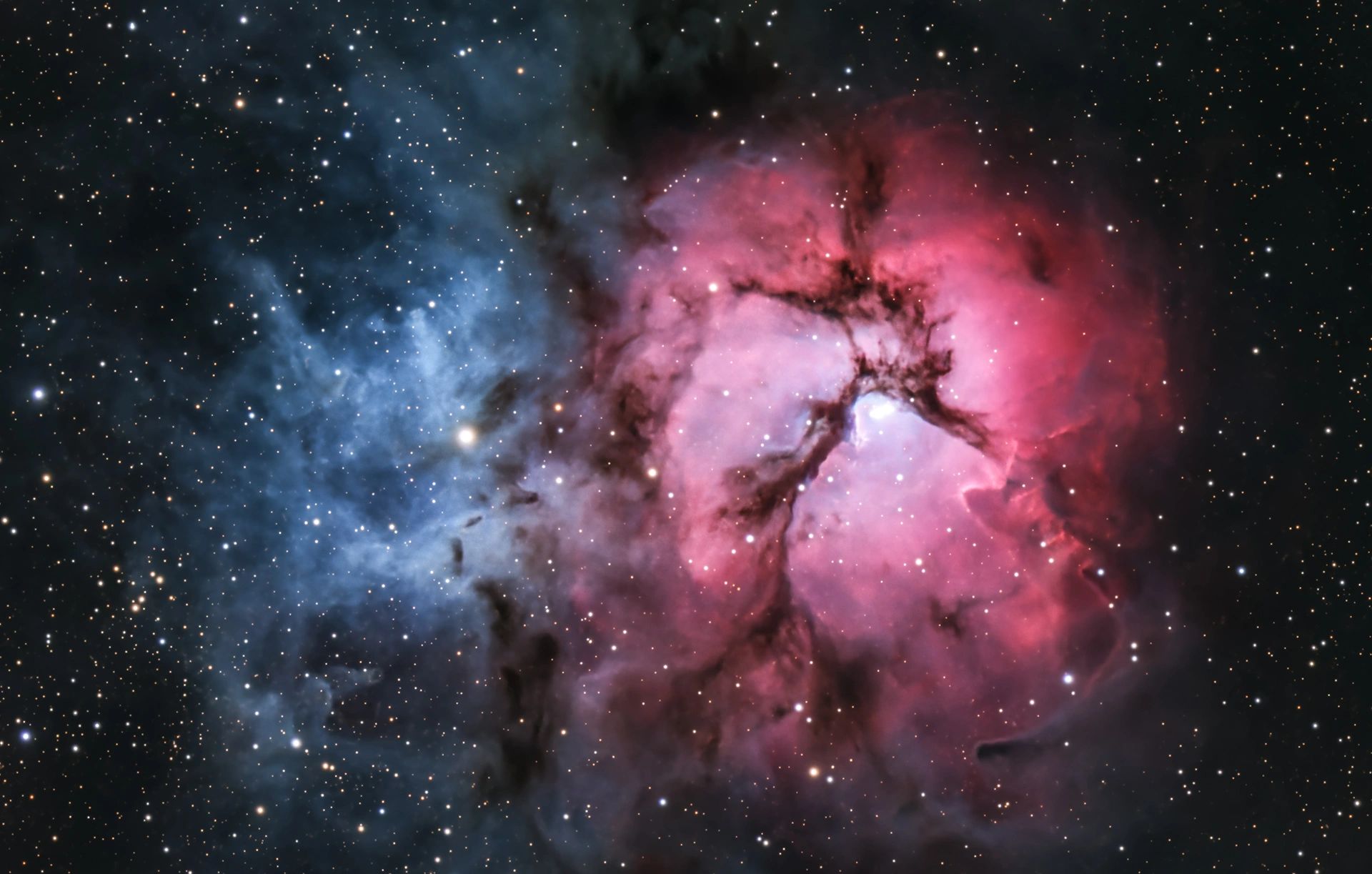
The Trifid Nebula (Summer)
Located in the constellation Sagittarius, the Trifid Nebula (M20) sits low in the southern sky. From my location in northern Wisconsin, it reaches a maximum altitude of 21 degrees. Don’t let that discourage you—the Trifid is still a beautiful and rewarding target.
The Trifid contains three types of nebulae. The red region is an emission nebula, the blue is a reflection nebula, and dark dust lanes divide the bright nebula into three lobes, giving the Trifid its name.
The Trifid is best photographed with broadband filters. While narrowband filters can capture the red hydrogen emission, they capture very little of the blue reflection nebula. Broadband imaging will give you the Trifid’s beautiful combination of red and blue.
Catalog Numbers
- M20
- NGC6514
- LBN27
Description
- Bright Nebula
- Magnitude: 6.30
- Apparent Size: 29.x27 arcmin
Location
- Constellation: Sagittarius
- RA: 18h 04m 02.7s
- Dec: -22d 58m' 16.4s

The East Nebula (Summer)
The Eastern Veil is part of the Cygnus Loop, a large supernova remnant in the constellation Cygnus. Its delicate filaments trace gas heated by the expanding shock wave from a star that exploded approximately 10,000 years ago. The Eastern and Western Veil are among the brightest visible portions of this remnant.
Imaging tips: The Eastern Veil is particularly well suited to narrowband imaging. Strong hydrogen-alpha (Hα) and oxygen-III (OIII) emissions reveal intricate filaments, typically rendered in red and blue-green. A dual-band Hα/OIII filter works well with color astronomy cameras, helping improve the nebula’s contrast against the dense star field and light pollution. Broadband RGB imaging can also capture the nebula under dark skies while preserving natural star colors. For both detailed nebulosity and natural star colors, consider combining narrowband exposures with RGB star data.
Catalog Numbers
- NGC6992
- NGC6995
- C33
Description
- Super Nove Remnant
- Magnitude: 5
- Apparent Size: 60 x 30 arcmin
Location
- Constellation: Cygnus
- RA: 20h 57m 23.9s
- Dec: 31d 30m' 52.2s

The Globular Custar M92 (Summer)
M92 is a globular cluster located approximately 27,000 light-years from Earth in the constellation Hercules. It was discovered by German astronomer Johann Elert Bode in 1777. With an apparent magnitude of 6.3, M92 is one of the brightest globular clusters in the Milky Way and can be seen with the unaided eye under excellent observing conditions at a dark-sky site.
Imaging tips: Start by achieving sharp focus, then take a few test frames to check that the bright stars and cluster core are not overexposed. Stacking 30–40 exposures of 30 seconds or less can be a useful starting point, but adjust the exposure length and number of frames to suit your equipment and sky conditions.
Catalog Numbers
- M92
- NGC6341
Description
- Globular Clustar
- Magnitude: 6.5
- Apparent Size: 14.0 arcmin
Location
- Constellation:Hercules
- RA: 17h 17m 57'1s
- Dec: 43d 06m' 25.6s

The Dumbbell Nebula (Summer/Fall)
The Dumbbell Nebula (M27) is a planetary nebula—a glowing cloud of gas cast off by an aging star. It is an emission nebula, rather than a reflection nebula: its gas emits light as it is energized by the hot stellar remnant at its center. Its distinctive shape and delicate filaments capture a brief, beautiful stage in the life of a star like our Sun.
Imaging tips: M27 works well with both RGB and narrowband imaging. RGB captures natural star colors and the bright main nebula, while narrowband filters isolate its strong hydrogen-alpha and oxygen-III emission.
Catalog Numbers
- M27
- NGC6853
- Hen2-452
Description
- Planetary Nebula
- Magnitude: 7.4
- Apparent Size: 8.0x5.7 arcmin
Location
- Constellation: Vulpecula
- RA: 20h 00m 45.2s
- Dec: 22d 47m' 22.0s
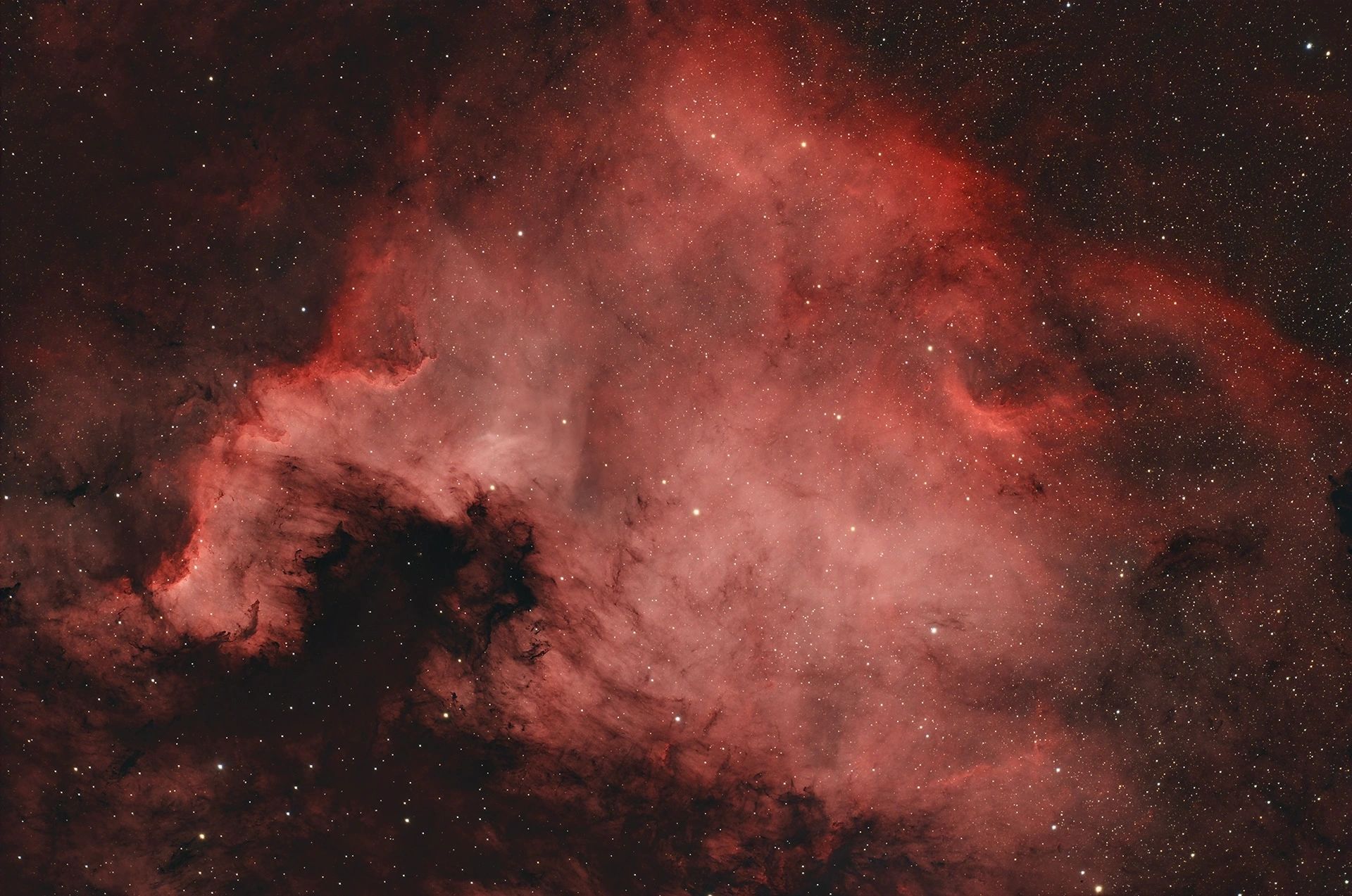
The North America Nebula (Fall)
The North America Nebula (NGC 7000) is a vast cloud of glowing gas in the constellation Cygnus, named for its resemblance to the continent. The “Gulf of Mexico” is especially recognizable, where dark foreground dust blocks the light from the nebula behind it.
Its large size makes it a rewarding target for wide-field astrophotography, with a camera lens or short focal-length telescope giving its familiar shape room to shine. Although it covers a generous patch of sky, its light is spread out, so dark skies and more total exposure time help reveal the faint detail. A camera sensitive to hydrogen-alpha light is especially helpful for capturing its rich red glow.
Catalog Numbers
- LBN 373
- NGC7000
- C 20
Description
- Emission Nebula
- Magnetude: 4.00
- Apparent Size: 120x100 arcmin
Location
- Constellation: Cygnus
- RA: 20h 51m 30s
- Dec: 41d 55m 36s

The Western Veil (Summer/Fall)
The Western Veil Nebula (NGC 6960), also known as the Witch’s Broom Nebula, is a delicate sweep of glowing filaments left behind by a massive star’s supernova explosion. It forms part of the larger Cygnus Loop, where expanding shock waves heat surrounding gas and cause it to shine. It is an emission nebula and supernova remnant, rather than a reflection nebula. Its twisting ribbons of hydrogen and oxygen trace the continuing aftermath of a stellar explosion thousands of years ago.
Imaging tips: The Western Veil is particularly well suited to narrowband imaging, with strong hydrogen-alpha and oxygen-III emission revealing intricate red and blue-green filaments. A dual-band Hα/OIII filter works well with color cameras. RGB imaging can capture the nebula under dark skies and preserve natural star colors, though narrowband helps separate its faint structure from the dense star field and light pollution.
Combining narrowband nebula data with RGB stars is an effective approach. Watch your exposure length around the bright foreground star 52 Cygni to avoid excessive
saturation.
Catalog Numbers
- LBN191
- NGC6960
- C 34
Description
- Super Nova Remnant
- Magnetude: 5.0
- Apparent Size: 70x6.0 arcmin
Location
- Constellation: Cygnus
- RA: 20h 47m 8.11s
- Dec: 30d 38m 39.3s
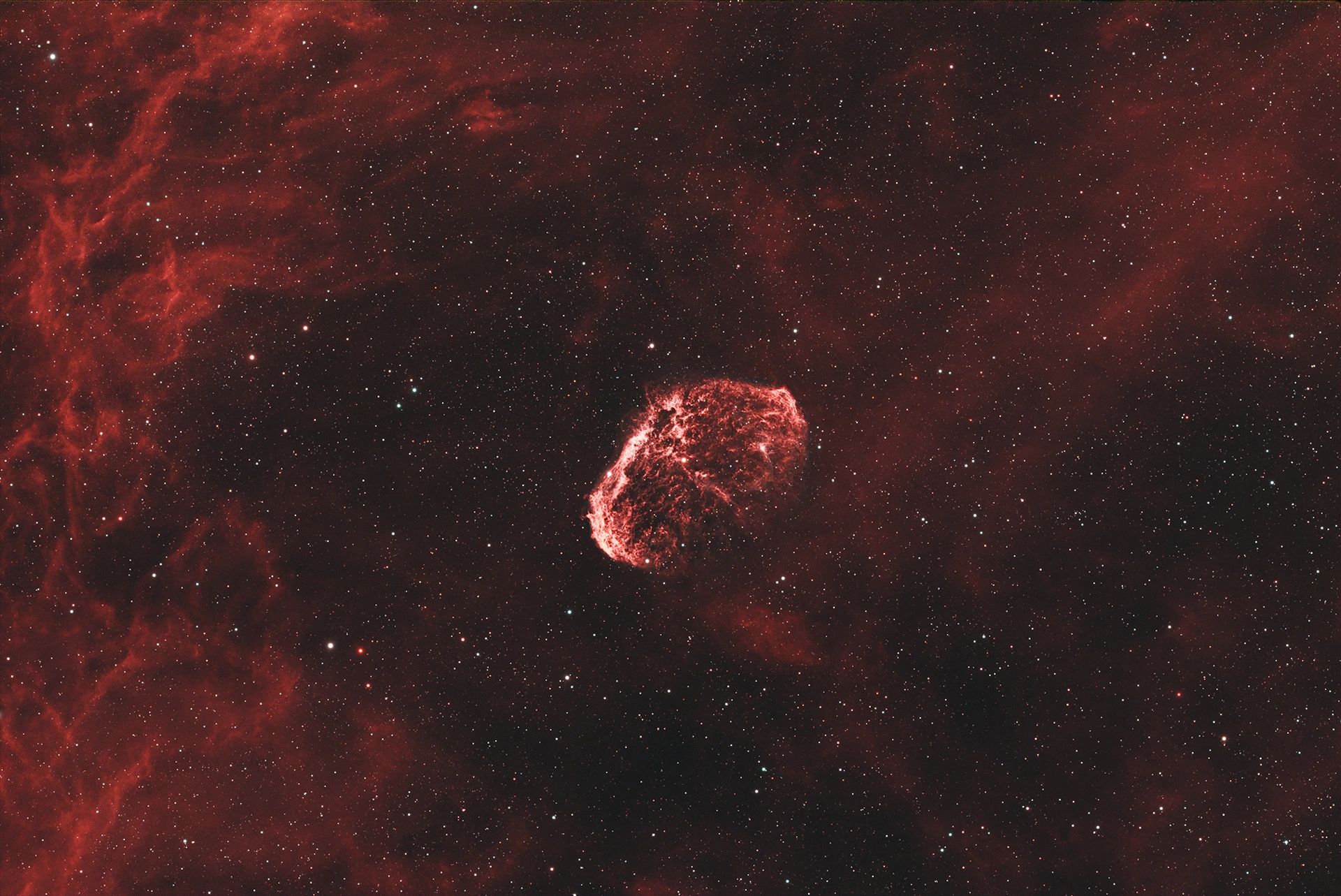
The Crescent Nebula (Summer/Fall)
The Crescent Nebula (NGC 6888) is an emission nebula shaped by powerful stellar winds from the massive Wolf–Rayet star WR 136. These winds collide with material the star shed earlier in its life, creating a curved shell of glowing gas threaded with delicate filaments. Its bright crescent and faint outer envelope offer rewarding detail for astrophotographers.
Imaging tips: The Crescent is particularly well suited to narrowband imaging. Hydrogen-alpha reveals its intricate filaments, while oxygen-III helps capture the faint outer shell. A dual-band Hα/OIII filter works well with colour cameras; separate filters suit monochrome cameras. RGB imaging can capture the nebula under dark skies and provides natural star colours to combine with narrowband data. Allow plenty of total exposure time for the faint oxygen emission, preferably under moonless conditions. Tight framing highlights the shell’s structure, while wider views include the surrounding hydrogen clouds and rich star field.
Catalog Numbers
- LBN 203
- NGC 6888
- C 27
Description
- Bright Nebula
- Magnetude: 7.4
- Apparent Size: 20 x 10 arcmin
Location
- Constellation: Cygnus
- RA: 20h 13m 9.95s
- Dec: 38d 26m 25.0s
Additional Summer Targets