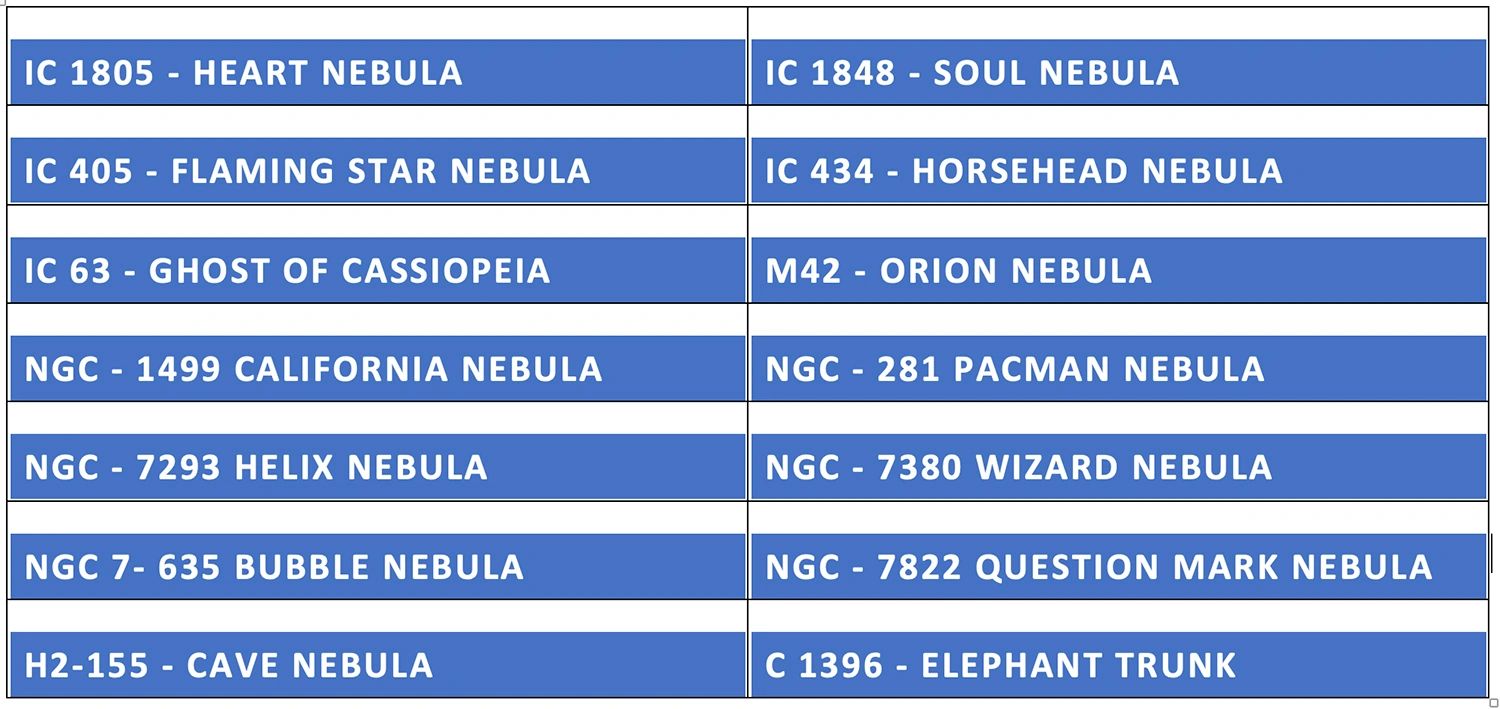
Welcome to The Cosmic Observatory – Astrophotography & Travel Blog

Pacman Nebula (Fall)
The Pacman Nebula (NGC 281) is an emission nebula located in the constellation Cassiopeia, about 9,500 light-years from Earth. Its familiar nickname comes from the dark dust lane cutting into its bright circular shape, giving it the appearance of the classic Pac-Man character.
At the heart of the nebula is a young open star cluster whose hot stars illuminate and energize the surrounding hydrogen gas. Dense clouds of dust and several dark Bok globules create striking structure throughout the nebula and are regions where new stars may be forming.
The Pacman Nebula is an excellent narrowband target, with strong hydrogen-alpha emission along with oxygen-III and sulfur-II. Its bright nebulosity and well-defined structure make it a rewarding target for both HOO and SHO processing.
Catalog Numbers
- LBN616
- NGC 281
- IC 1590
Description
- Bright Nebula
- Magnitude: 7.4
- Apparent Size: 35 x 30 arcmin
Location
- Constellation: Cassiopeia
- RA: 00h 54m 11.9s
- Dec: 56d 48m' 38.1s
Andromeda Galaxy (Fall)
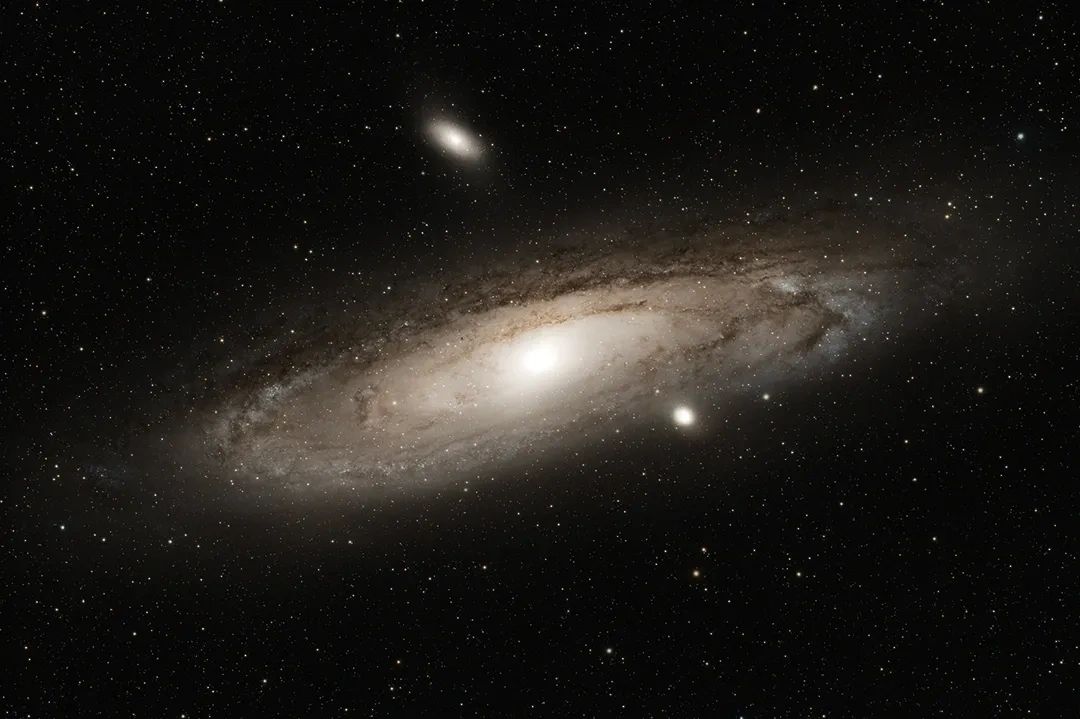
M31, commonly known as the Andromeda Galaxy, is a spiral galaxy located approximately 2.5 million light-years from Earth in the constellation Andromeda. It is the nearest large galaxy to the Milky Way and is visible to the unaided eye under dark skies. Its bright central bulge, sweeping dust lanes, and faint outer arms make it a rewarding astrophotography target. NASA
Imaging tips: M31’s large apparent size makes it well suited to a short-focal-length telescope or telephoto lens. Broadband RGB imaging captures its star colors and dust lanes well. Take test frames to avoid overexposing the bright core, and consider blending shorter exposures for the center with longer exposures for the faint outer regions. More total integration time will help reveal subtle detail in the galaxy’s outskirts.
Catalog Numbers
- M 31
- NGC 224
- UGC 454
Description
- Spiral Galaxy
- Magnitude: 3.4
- Apparent Size: 189. x 61.7 arcmin
Location
- Constellation: Andromeda
- RA: 00h 44m 12.7s
- Dec: 41d 25m' 00.3s
Cave Nebula (Fall)
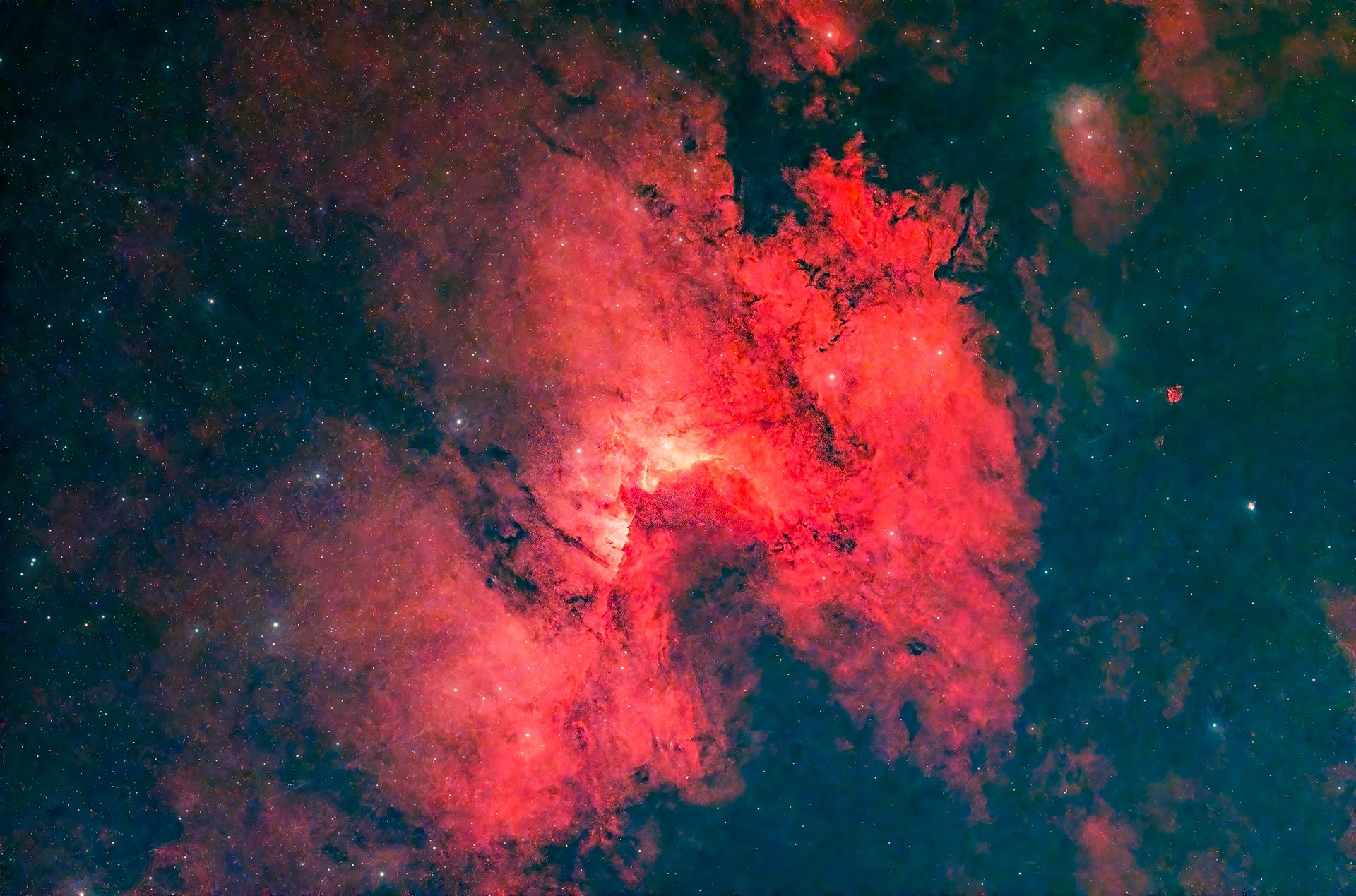
The Cave Nebula, also known as Sh2-155 or Caldwell 9, is a star-forming region located approximately 3,000 light-years from Earth in the constellation Cepheus. Its name comes from the dark, cavern-like opening bordered by a bright arc of glowing hydrogen gas. Part of the larger Cepheus B cloud, this region contains young, hot stars that illuminate and shape the surrounding gas and dust. NASA
Imaging tips: The Cave Nebula’s faint structure benefits from several hours of total integration time. An Hα filter, or a dual-band filter with a color astronomy camera, can help bring out the glowing hydrogen along the cave’s rim. Broadband RGB exposures are useful for capturing surrounding reflection nebulosity and natural star colors. Combining Hα and RGB data can reveal both the bright emission and the more subtle surrounding clouds.
Catalog Numbers
- Sh2-155
- LBN 27
- MC 9
Description
- Bright Nebula
- Magnitude: 7.89
- Apparent Size: 50 x 30 arcmin
Location
- Constellation: Cepheus
- RA: 22h 57m 51.1s
- Dec: -62d 45m' 38.2s
The Bubble Nebula (Fall)
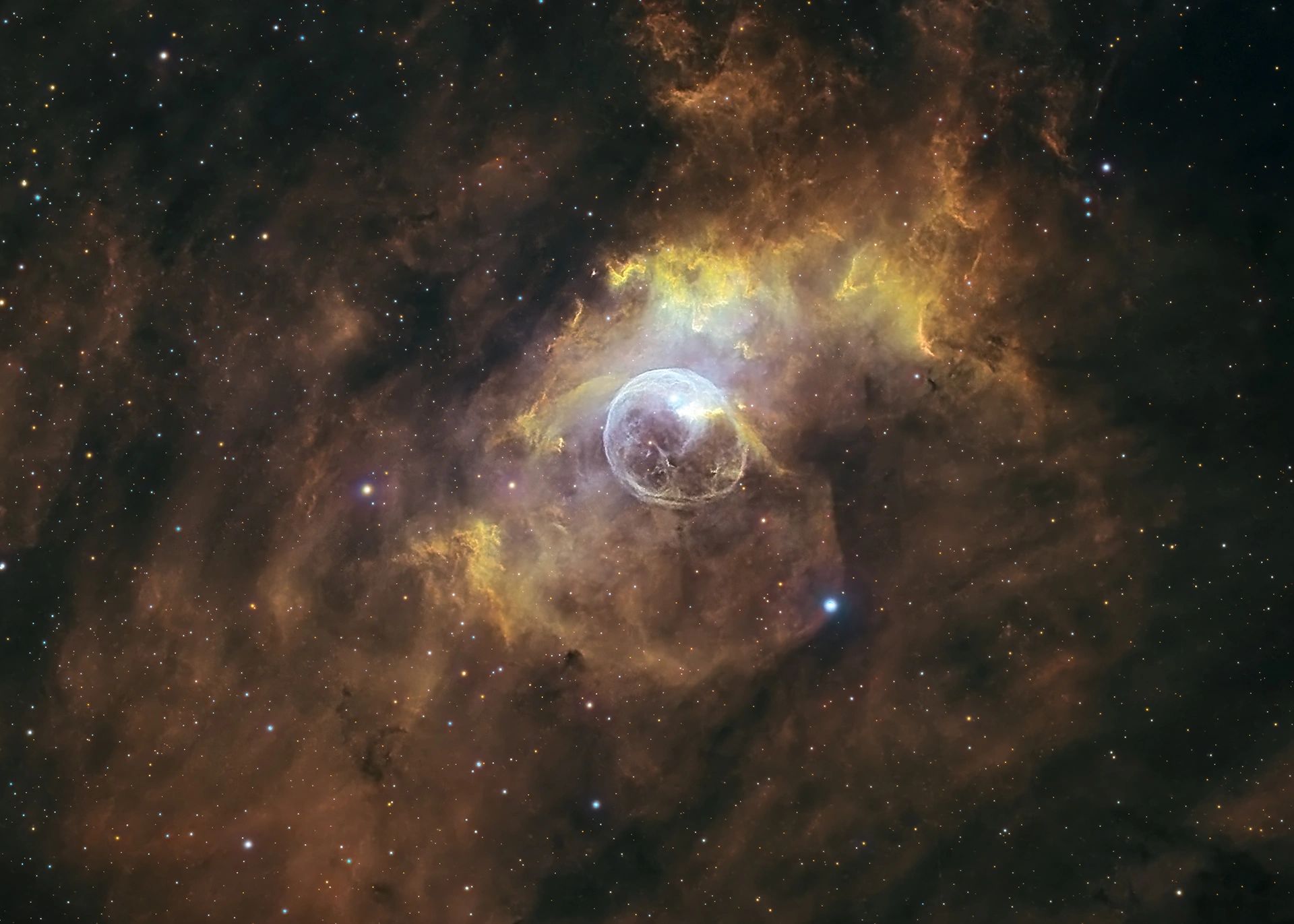
The Bubble Nebula (NGC 7635) is an emission nebula located in the constellation Cassiopeia, about 7,000 light-years from Earth. Its most striking feature is the nearly perfect bubble of glowing gas that gives the nebula its name.
The bubble is being created by powerful stellar winds from a massive, hot star located inside it. These winds push outward against the surrounding interstellar gas, forming an expanding shell roughly seven light-years across. The bright surrounding clouds of hydrogen are energized by ultraviolet radiation from the same star.
The Bubble Nebula is an excellent target for
narrowband astrophotography. Hydrogen-alpha provides much of its bright red structure, while oxygen and sulfur emissions can reveal additional detail and color. Longer exposures bring out the faint surrounding nebulosity and make the delicate bubble stand out against the rich star fields of Cassiopeia.
Catalog Numbers
- Ibn 548
- NGC 7635
- C 11
Description
- Emission Nebula
- Magnitude: 11
- Apparent Size: 15 x 8 arcmin
Location
- Constellation: Cassiopéia
- RA: 23h 21m 52.9s
- Dec: 61d 20m' 51.4s

The Helix Nebula (Fall)
he Helix Nebula (NGC 7293) is a large planetary nebula located in the constellation Aquarius, about 650 light-years from Earth. It is one of the closest planetary nebulae to our solar system and appears nearly as large as the full Moon in the night sky.
Despite its size, the Helix has a relatively low surface brightness and benefits from dark skies and plenty of exposure time. Its glowing shell consists mainly of hydrogen and oxygen gas expelled by a Sun-like star near the end of its life. The remaining white dwarf can be seen near the center of the nebula.
Astrophotographers often use narrowband filters to bring out the Helix's intricate structure. Strong hydrogen-alpha and oxygen-III emissions produce its characteristic red and blue-green colors, while deeper exposures can reveal the much fainter outer regions surrounding the familiar central ring.
Catalog Numbers
- NGC 7293
- ARO 17
- C 63
Description
- Planetary Nebula
- Magnitude: 7.59
- Apparent Size: 14.7x12.0 arcmin
Location
- Constellation: Aquarius
- RA: 22h 31m 07.02s
- Dec: -20d 41m' 58.3s
The Wizard Nebula (Fall)
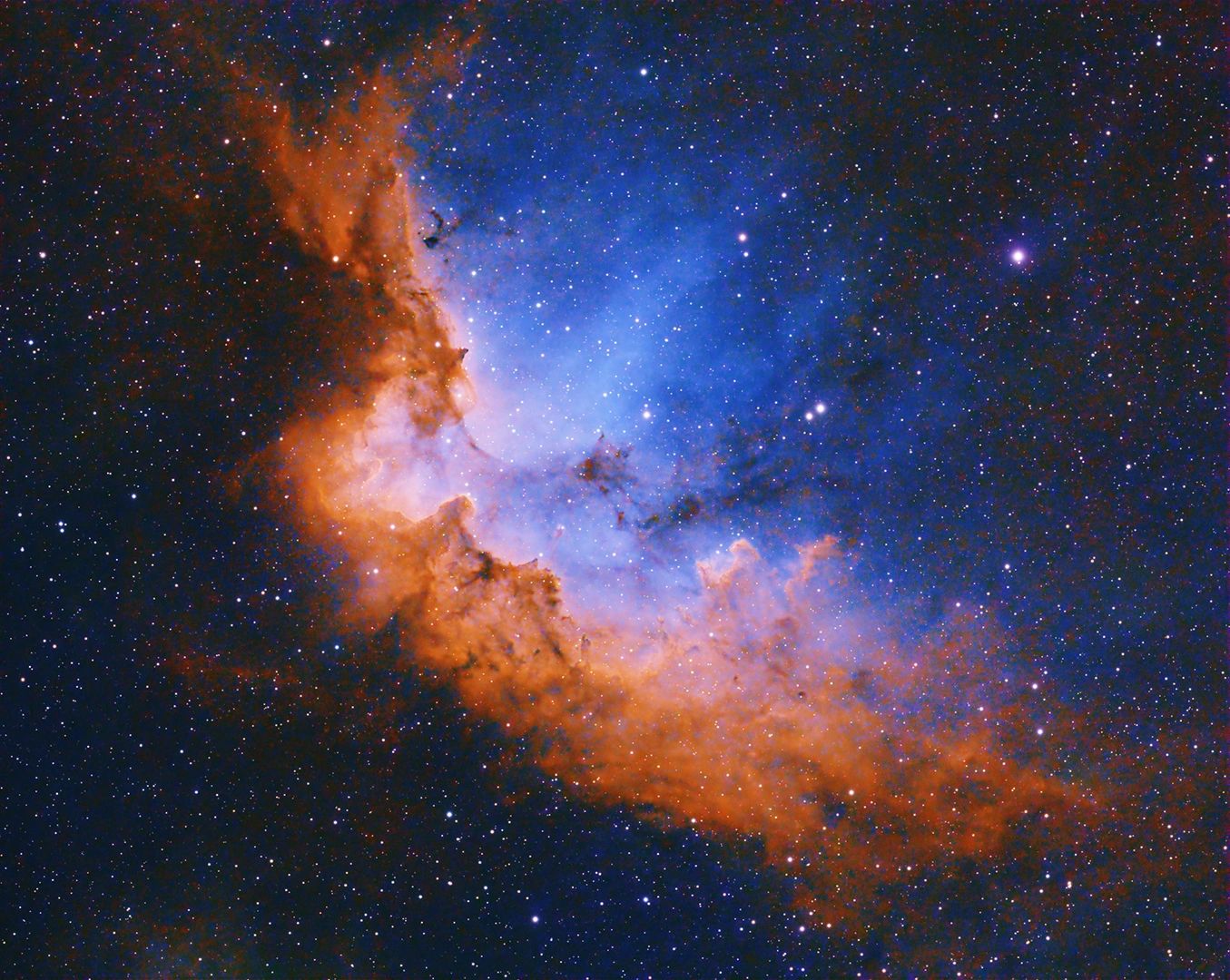
The Wizard Nebula (NGC 7380) is an emission nebula located in the constellation Cepheus, about 7,000 light-years from Earth. Its name comes from the distinctive shape formed by the glowing gas and dark dust, which resembles a wizard wearing a pointed hat.
The nebula surrounds a young open star cluster whose hot, massive stars provide the ultraviolet radiation that causes the surrounding hydrogen gas to glow. Dark lanes of dust wind through the brighter regions, creating the intricate structure that makes the Wizard such an interesting photographic target.
The Wizard Nebula is especially well suited to narrowband imaging. Strong hydrogen-alpha, oxygen-III, and sulfur-II emissions make it an excellent target for both HOO and SHO color combinations. Longer exposures reveal faint nebulosity extending well beyond the brighter central region.
Catalog Numbers
- LBN511
- NGC738
- Hercules Cluster
Description
- BRIGHT NEBULA
- Magnetude: 5.80
- Apparent Size: 25 x 30 arcmin
Location
- Constellation: Cepheus
- RA: 22h 48m 4.0s
- Dec: 58d 14m' 31.2s
The Cocoon Nebula (Fall)
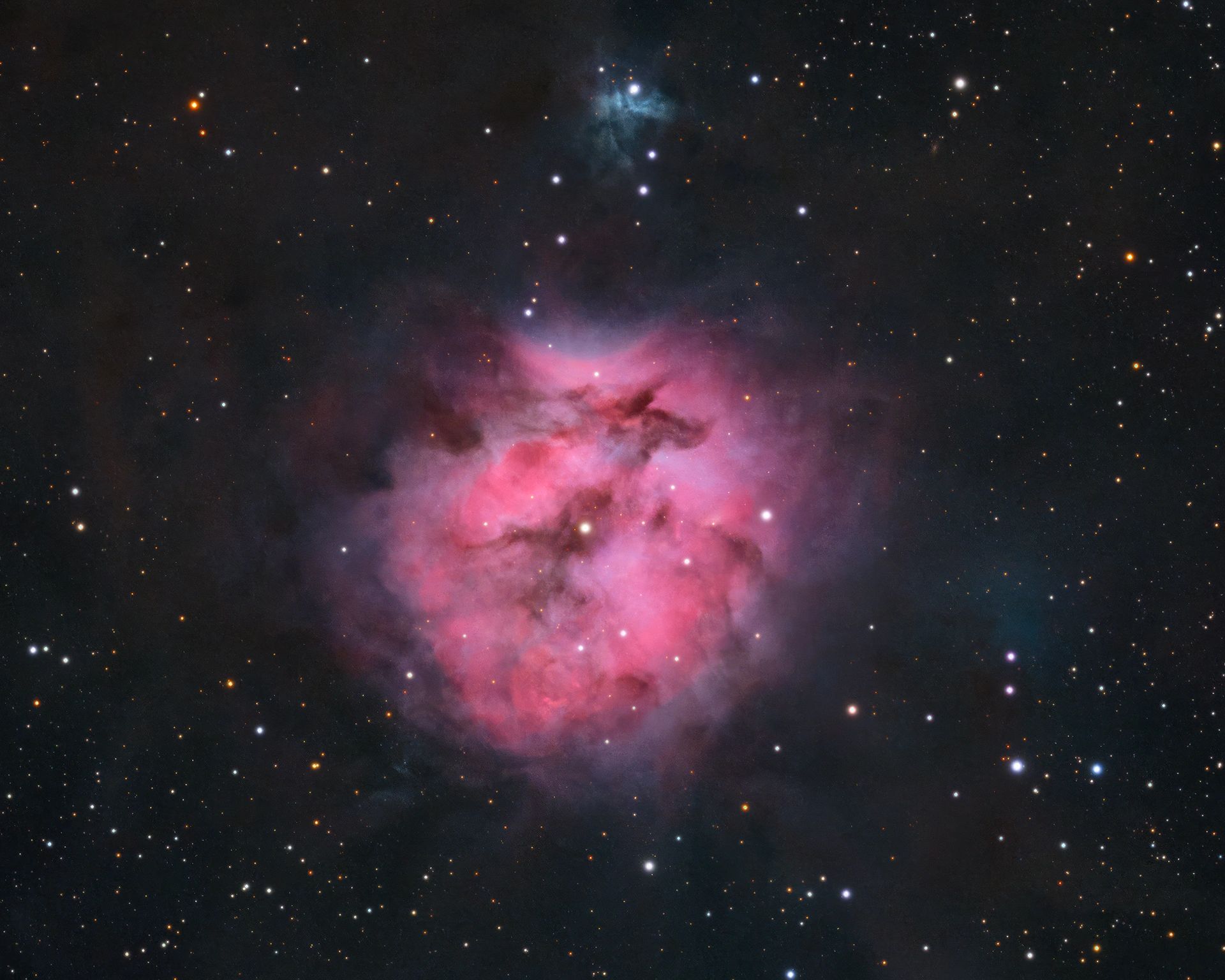
The Cocoon Nebula (IC 5146) in Cygnus combines red hydrogen emission, faint blue reflection nebulosity, and the dark dust trail Barnard 168. Its bright core spans about 12 arc-minutes, making it suitable for detailed telescope images, while wider fields reveal the surrounding dust.
It's best placed for Northern Hemisphere imaging in late summer and early autumn, the Cocoon benefits from dark, moonless skies and capture near its highest altitude. Use broadband RGB or LRGB to preserve star colors and reflection nebulosity, with optional H-alpha to enhance the red emission. Plan several hours of exposure, allowing more time for faint dust. When framing, leave space west of the nebula for Barnard 168. l
Catalog Numbers
- IC 5146
- B 168
- Sh2-125
Description
- Bright Nebula
- Magnitude: Unknown
- Apparent Size: 12 arcmin
Location
- Constellation: Cygnus
- RA: 21h 54m 24.4s
- Dec: 47d 24m' 07.9s
The Iris Nebula (Fall)
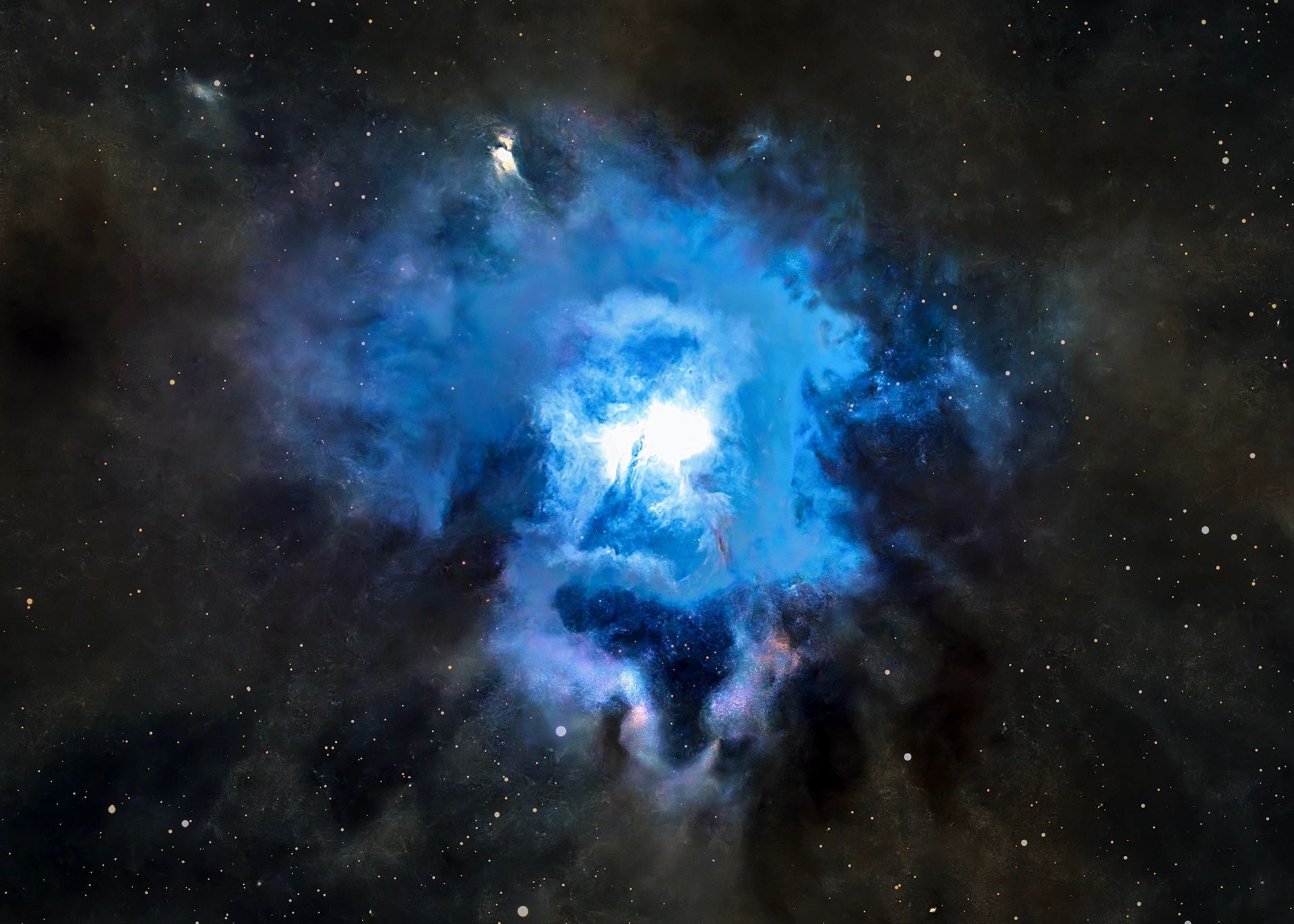
The Iris Nebula (NGC 7023) is a reflection nebula located in the constellation Cepheus, about 1,300 light-years from Earth. Its delicate blue petals surrounding a bright central star give the nebula the flower-like appearance that inspired its name.
Unlike an emission nebula, the Iris does not produce most of the visible light we see. Instead, dust surrounding the central star reflects and scatters its light, producing the beautiful blue color. Dark clouds of interstellar dust surround the brighter central region and extend across a much larger area.
The Iris is best photographed with broadband filters under dark skies. Narrowband filters are generally not advantageous because the blue nebulosity is reflected starlight rather than strong emission from ionized gas. Longer integration times can reveal the extensive, faint dust surrounding the bright central Iris.
Catalog Numbers
- NGC 7023
- LBN 487
- C 7
Description
- Planetary Nebula
- Magnitude: 7.4
- Apparent Size: 8.0x5.7 arcmin
Location
- Constellation: Vulpecula
- RA: 20h 00m 45.2s
- Dec: 22d 47m' 22.0s
The North America Nebula (Fall/Summer)
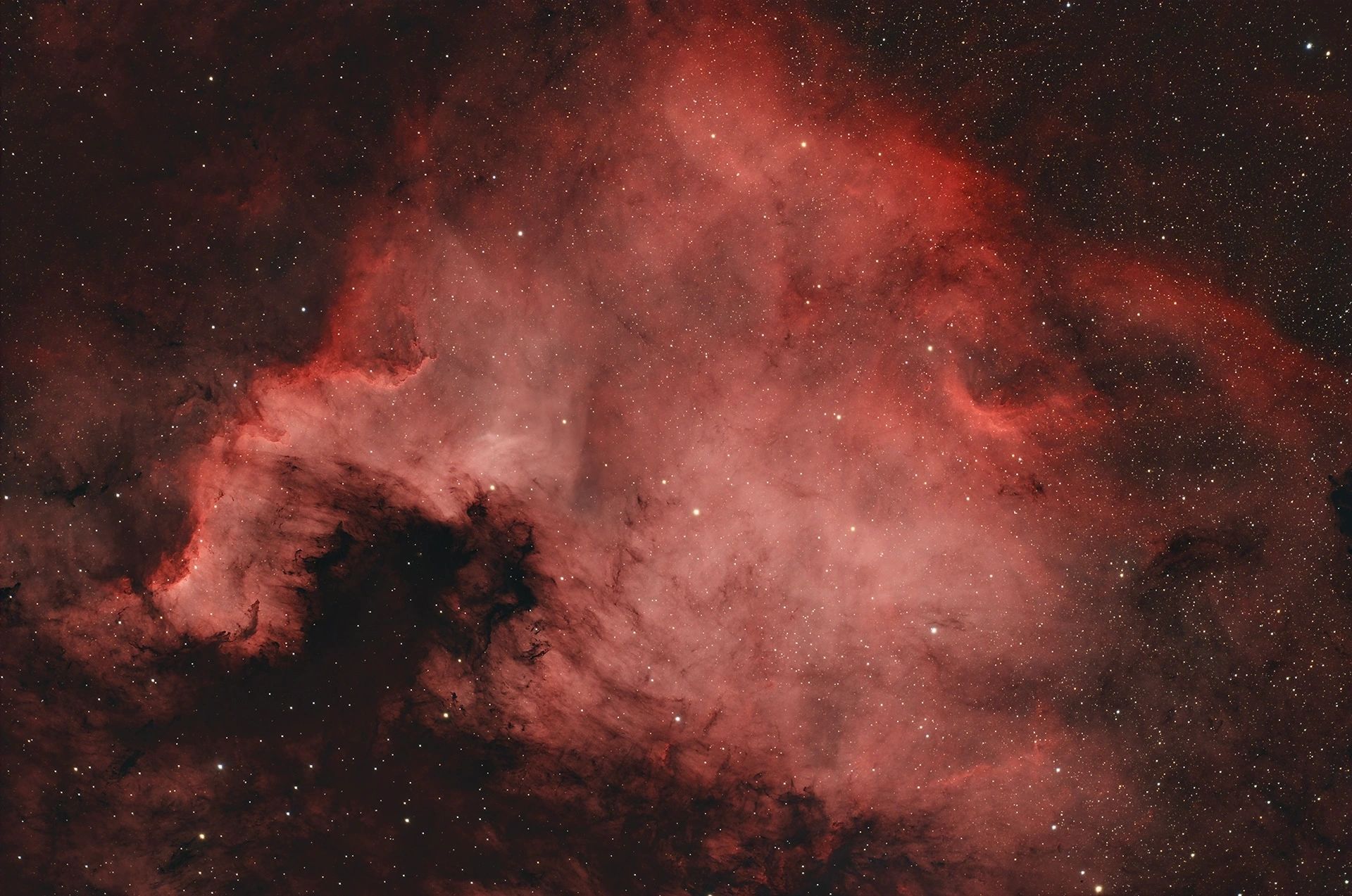
The North America Nebula (NGC 7000) is a vast cloud of glowing gas in the constellation Cygnus, named for its resemblance to the continent. The “Gulf of Mexico” is especially recognizable, where dark foreground dust blocks the light from the nebula behind it.
Its large size makes it a rewarding target for wide-field astrophotography, with a camera lens or short focal-length telescope giving its familiar shape room to shine. Although it covers a generous patch of sky, its light is spread out, so dark skies and more total exposure time help reveal the faint detail. A camera sensitive to hydrogen-alpha light is especially helpful for capturing its rich red glow.
Catalog Numbers
- LBN 373
- NGC7000
- C 20
Description
- Emission Nebula
- Magnetude: 4.00
- Apparent Size: 120x100 arcmin
Location
- Constellation: Cygnus
- RA: 20h 51m 30s
- Dec: 41d 55m 36s

The Western Veil Nebula (Fall)
The Western Veil Nebula (NGC 6960), also known as the Witch’s Broom Nebula, is a delicate sweep of glowing filaments left behind by a massive star’s supernova explosion. It forms part of the larger Cygnus Loop, where expanding shock waves heat surrounding gas and cause it to shine. It is an emission nebula and supernova remnant, rather than a reflection nebula. Its twisting ribbons of hydrogen and oxygen trace the continuing aftermath of a stellar explosion thousands of years ago.
Imaging tips: The Western Veil is particularly well suited to narrowband imaging, with strong hydrogen-alpha and oxygen-III emission revealing intricate red and blue-green filaments. A dual-band Hα/OIII filter works well with color cameras. RGB imaging can capture the nebula under dark skies and preserve natural star colors, though narrowband helps separate its faint structure from the dense star field and light pollution.
Combining narrowband nebula data with RGB stars is an effective approach. Watch your exposure length around the bright foreground star 52 Cygni to avoid excessive
saturation.
Catalog Numbers
- LBN191
- NGC6960
- C 34
Description
- Super Nova Remnant
- Magnetude: 5.0
- Apparent Size: 70x6.0 arcmin
Location
- Constellation: Cygnus
- RA: 20h 47m 8.11s
- Dec: 30d 38m 39.3s
Strong Narrowband Targets For Fall
Use your narrow band filters (Ha, O3, and S2), to see your images in greater detail.
HOO-SHO-HaRGB or go your own way