Welcome to The Cosmic Observatory – Astrophotography & Travel Blog
Soul Nebula (Winter)
The Soul Nebula (IC 1848) is a sprawling emission nebula filled with glowing gas, dark dust pillars, and clusters of young stars. Radiation and stellar winds from its massive stars carve cavities into the surrounding clouds, creating bright rims and intricate structures. Its sweeping outline makes an attractive wide-field subject, while closer views reveal the sculpted edges of this active stellar nursery.
Imaging tips: Narrowband imaging is especially effective, with strong hydrogen-alpha emission revealing the nebula’s structure. A dual-band Hα/OIII filter suits colour cameras, while monochrome imagers can add SII for a three-channel narrowband palette. RGB works under dark skies and provides natural star colours to combine with narrowband data. Check your framing carefully—the full nebula needs a generous field of view. Plan several hours of total exposure, allowing extra time for the weaker oxygen signal and faint outer nebulosity.
hiCatalog Numbers
- IC 1848
- LBN 667
- CL 34
Description
- Emission Nebula
- Magnitude: 6.50
- Apparent Size: 600. x 30 arcmin
Location
- Constellation: Cassiopeia
- RA:200h 56m 41.3s
- Dec: 60d 30m12.6s

California Nebula (Winter)
The California Nebula (NGC 1499) is an elongated emission nebula named for its resemblance to the outline of California. Its red hydrogen glow is powered primarily by radiation from the nearby hot star Xi Persei. Bright ridges and delicate filaments run along its length, giving way to faint, wispy edges that reward deeper exposures.
Imaging tips: Its large size makes the California ideal for a short focal-length telescope or telephoto lens. Check your framing and camera rotation to fit its long outline, leaving room around the faint edges. Hydrogen-alpha captures strong detail and contrast; a dual-band filter works well with colour cameras, while monochrome imagers can combine Hα with RGB for natural star colours. Broadband RGB is also effective under dark skies, especially with a camera sensitive to Hα. Plan several hours of total exposure to bring out subtle structure and the fainter outskirts.
Catalog Numbers
- LBN 756
- NGC 1499
- SH2-20
Description
- Bright Nebula
- Magnitude: 5.00
- Apparent Size: 145 x 40 arcmin
Location
- Constellation: Perseus
- RA: 04h 02m 45..9s
- Dec: 38d 31m 53.0s
Horsehead Nebula (Winter)
The Horsehead Nebula (Barnard 33) is a dense cloud of dark dust silhouetted against the glowing hydrogen of IC 434. Its distinctive shape contrasts beautifully with the nearby Flame Nebula (NGC 2024), an emission nebula crossed by branching dark dust lanes. Together with the bright star Alnitak and surrounding reflection nebulosity, they create a richly detailed composition.
Imaging tips: Frame generously to include both nebulae and their surrounding clouds. Broadband RGB captures the varied colours, reflection nebulosity, and natural star colours, especially under dark, moonless skies. Adding Hα strengthens the red emission behind the Horsehead, making its silhouette more distinct. A dual-band filter is useful for colour cameras, though broadband data helps preserve the full scene. Check test exposures for glare and filter halos around Alnitak, and consider shorter exposures to blend into the brightest areas. Several hours of total exposure will help reveal faint dust and smoother background detail.
https://science.nasa.gov/image-article/apod-2022-december-29-horsehead-and-flame/
Catalog Numbers
- B 33
- LBN 1630
- IC 434
Description
- Dark Nebula
- Magnitude: Unknown
- Apparent Size: 6.0 x 4.0 arcmin
Location
- Constellation: Orion
- RA: 05h 42m15.3.s
- Dec: -02d 27m 08.5s
The Tadpole & Flaming Star Nebulae (Winter)
The Tadpole Nebula (IC 410) and Flaming Star Nebula (IC 405) make a striking pairing of glowing gas, dark dust, and young stars. The Tadpole is an emission nebula containing two distinctive trails of gas and dust sculpted by radiation and stellar winds from its central star cluster. The Flaming Star combines red hydrogen emission with delicate blue reflection nebulosity around the hot star AE Aurigae, adding colour and texture to the shared field.
Imaging tips: A short focal-length telescope and careful camera rotation help fit both nebulae while leaving room for their faint outer clouds. Hα reveals strong structure in both targets, and a dual-band Hα/OIII filter works well with colour cameras. Include broadband RGB to capture the Flaming Star’s blue reflection nebulosity and natural star colours. Dark, moonless conditions are especially helpful for that faint reflected light. Plan several hours of total exposure, and expect the small tadpole features to appear subtle in a wide-field image.
Catalog Numbers
- NGC 1893
- IC 410
- LBN 807
Description
- Emission Nebula
- Magnitude: 10.00
- Apparent Size: 40 x 30 arcmin
Location
- Constellation: Auriga
- RA: 05h 24m 50s
- Dec: 33d 36m 16.5s
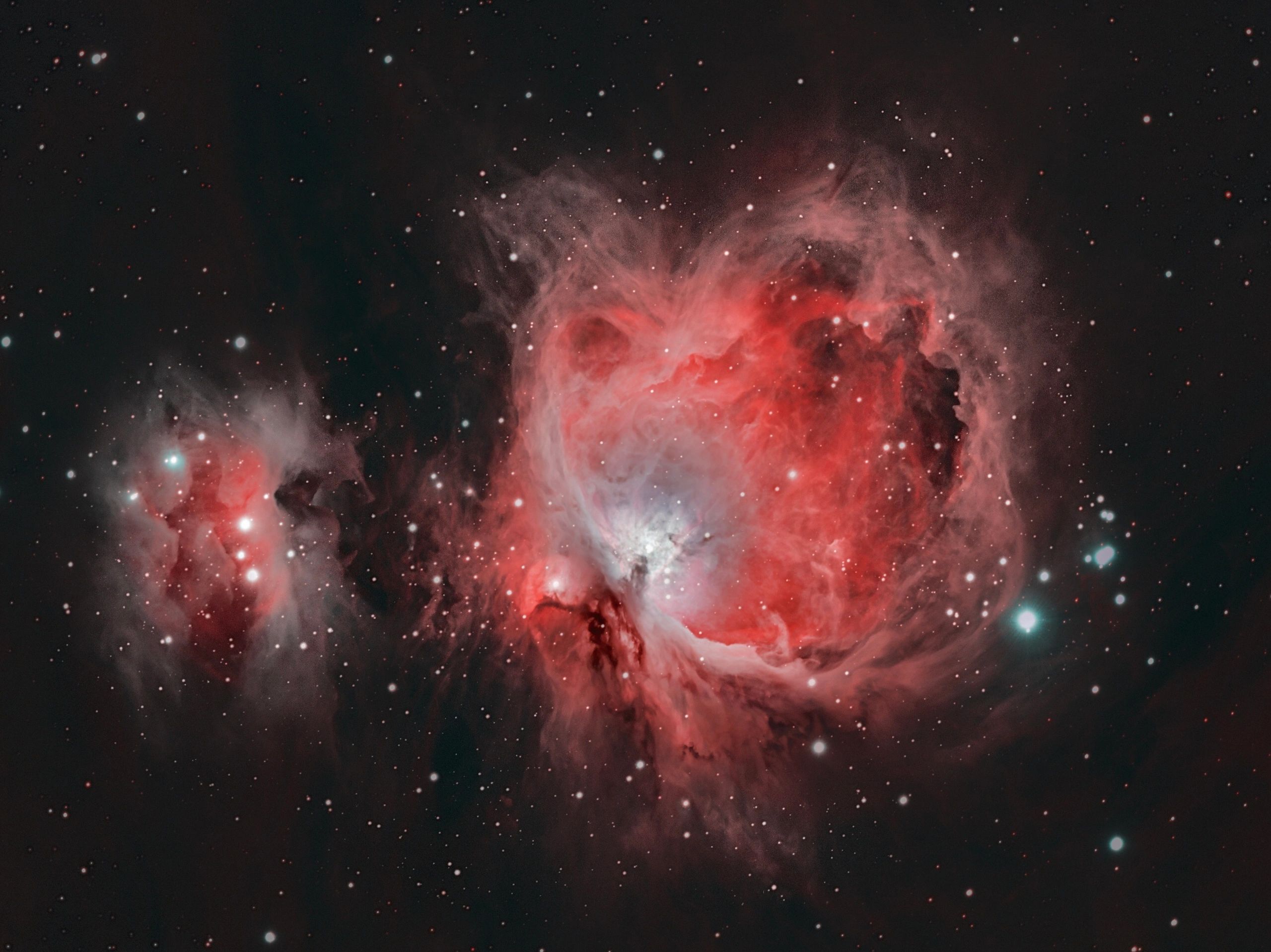
The Orion Nebula (Winter)
The Orion Nebula (M42) and nearby Running Man Nebula form a colourful pairing of glowing gas and reflected starlight. Orion is a bright emission nebula where young stars illuminate sweeping clouds surrounding the central Trapezium cluster. The Running Man is dominated by blue reflection nebulosity, with dark dust creating the silhouette that gives it its name. Together, they offer bright detail and faint surrounding clouds in a single frame.
Imaging tips: Broadband RGB or LRGB is ideal for capturing both targets, preserving the Running Man’s blue glow and natural star colours. Hα can enhance Orion’s emission, but include broadband data for the reflection nebulosity. Capture short exposures for Orion’s brilliant core and longer exposures for the faint outer clouds, then blend them to retain detail throughout. Check that the Trapezium region remains unsaturated in your shortest frames. Leave space around both nebulae, and use several hours of total exposure under dark, moonless skies to reveal the surrounding dust.
Catalog Numbers
- NGC 1976
- M42
- LBN 974
Description
- Bright Nebula
- Magnitude: 4.0
- Apparent Size: 85x60 arcmin
Location
- Constellation: Orion
- RA: 05h 36m 19.1s
- Dec: -05d 32m 43.8s
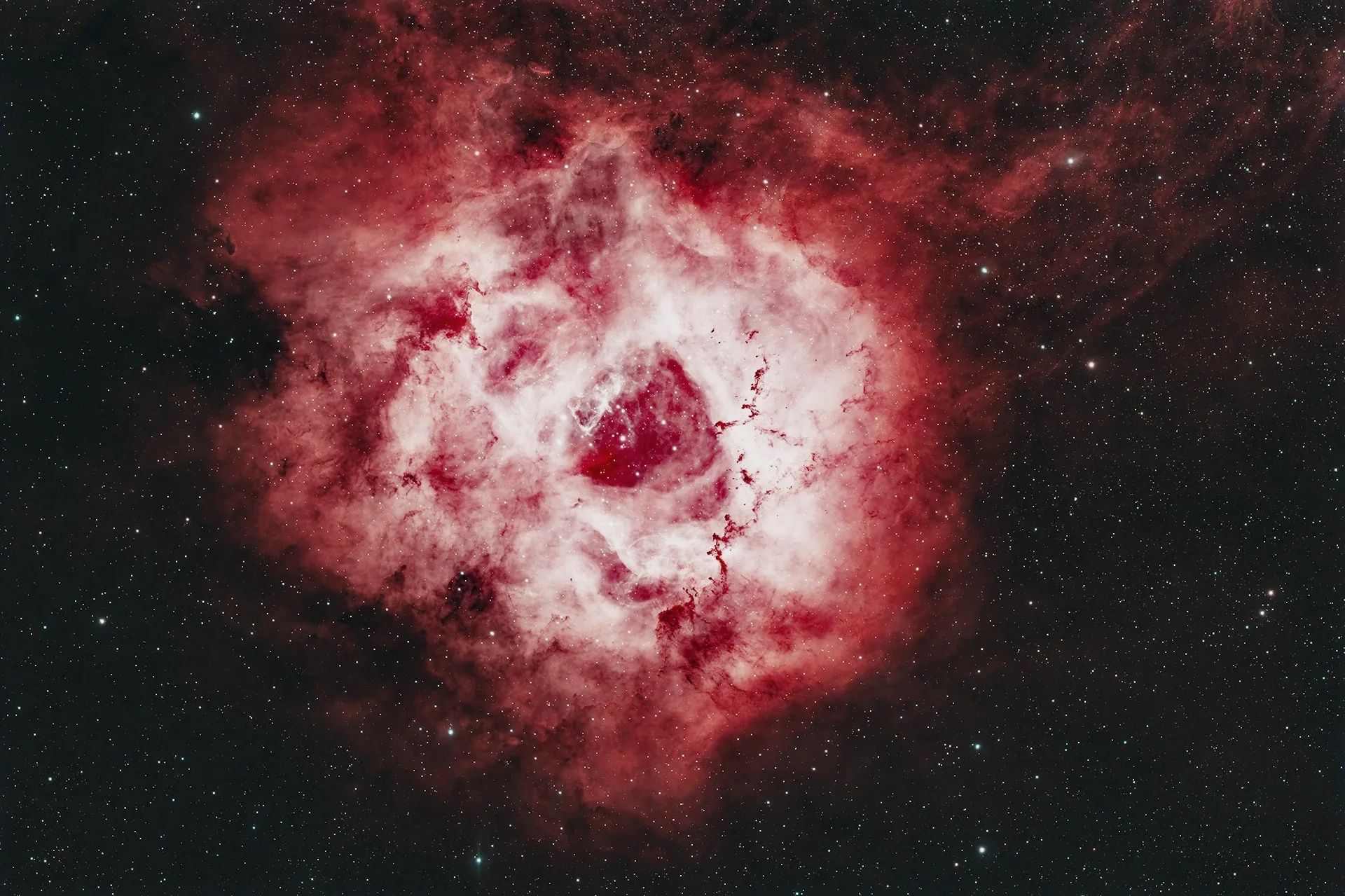
The Rosette Nebula (Winter)
The Rosette Nebula is a large emission nebula whose flower-like shape surrounds the young star cluster NGC 2244. Radiation and stellar winds from these hot stars have cleared its central cavity and sculpted the surrounding gas into bright ridges, dark dust pillars, and delicate filaments. Its broad outline makes an attractive wide-field target, while closer views reveal intricate detail along the cavity’s edges.
Imaging tips: A short focal-length telescope works well for capturing the full Rosette, with room around its faint outer petals. Narrowband imaging is especially effective: a dual-band Hα/OIII filter suits colour cameras, while monochrome imagers can add SII for a three-channel palette. Broadband RGB captures the nebula under dark skies and provides natural colours for the central star cluster. Check exposures to avoid saturating those bright stars, and plan several hours of total exposure to reveal faint outer structure. Careful background correction helps preserve the extended nebulosity.
Catalog Numbers
- LBN948
- NGC2244
- NGC 2237
Description
- Bright Nebula
- Magnetude: 6.5
- Apparent Size: 80 x 60arcmin
Location
- Constellation: Monoceros
- RA:062h 33m 51.6s
- Dec: 05d 04m 45.7s
The Pleiades Star Cluster (Winter)
The Pleiades (M45), also known as the Seven Sisters, is an open star cluster surrounded by delicate blue reflection nebulosity. Its brilliant stars illuminate a passing cloud of interstellar dust, revealing wispy streaks and finely textured filaments. The contrast between bright blue-white stars and faint dust makes this familiar cluster a rewarding photographic target.
Imaging tips: Use broadband RGB or LRGB to capture the reflected starlight; narrowband and dual-band filters suppress much of this target’s light. A short focal-length telescope or telephoto lens provides room for the cluster and surrounding dust. Prioritize dark, moonless skies and several hours of total exposure to reveal the faint nebulosity. Check individual exposures for star saturation, and consider a separate set of shorter exposures to preserve the brightest stars’ colours when blending. Use gentle stretching and careful background correction so the subtle dust is preserved.
Catalog Numbers
- M45
- Mel 22
- NGC 1435
Description
- Open Clustar
- Magnitude: 1.5
- Apparent Size: 120 arcmin
Location
- Constellation: Taurus
- RA: 03h 48m 48.5s
- Dec: 24d 12m 01.5s
The Monkey Head Nebula (Winter)
The Monkey Head Nebula (NGC 2174) is an emission nebula whose rounded outline and dark dust clouds suggest the profile of a monkey’s head. Hot young stars energize the surrounding hydrogen gas, while radiation and stellar winds sculpt bright ridges, pillars, and dense knots of dust. These contrasting features provide interesting detail within its softly glowing outer edges.
Imaging tips: Narrowband imaging works particularly well, with Hα revealing strong structure and OIII adding contrast within the glowing gas. A dual-band Hα/OIII filter suits colour cameras, while monochrome imagers can include SII for a three-channel palette. Broadband RGB is also effective under dark skies and provides natural star colours to combine with narrowband data. Frame with some space around the nebula to preserve its distinctive outline and faint outskirts. Plan several hours of total exposure, and use gentle processing to retain the separation between bright rims and dark dust.
Catalog Numbers
- IC 2159
- LBN 854
- NGC 2175
Description
- Bright Nebula
- Magnitude: Unknown
- Apparent Size: 40x30arcmin
Location
- Constellation: Orion
- RA: 06h 11m 35.2s
- Dec: 20d 29m 04.8s